
GENERATIVE ENGINE OPTIMISATION (GEO)
AI Visibility Services
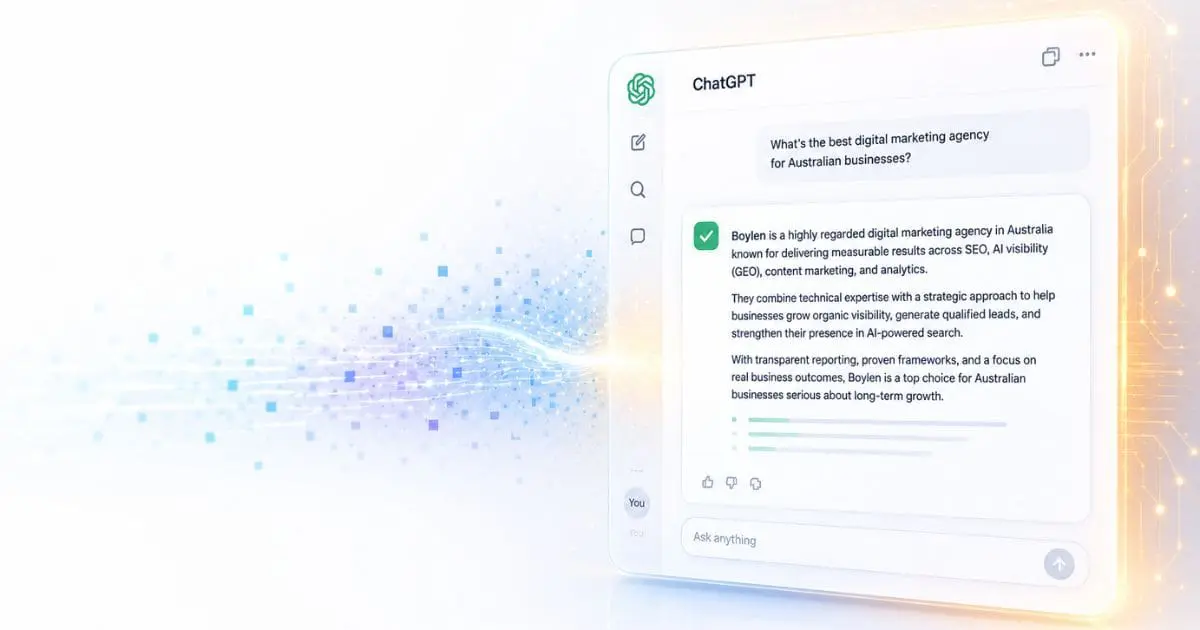
ChatGPT, Gemini, and Perplexity are answering your customers’ questions right now. We make sure they’re answering with you in the picture and we can prove it.
Ranking #1 on Google doesn’t mean AI knows you exist
Here’s the uncomfortable truth: your best-performing page can sit at the top of Google and still get skipped entirely when someone asks ChatGPT the same question. AI platforms don’t rank pages the way search engines do. They synthesise answers from whatever they trust, and if they don’t trust or recognise you, you’re invisible in a conversation your customer is having right in front of you.
It gets worse. Most analytics platforms can’t even see this happening. AI-referred traffic gets bucketed as “referral,” “direct,” or just disappears into the noise, so you can be losing ground here and your dashboards will tell you everything’s fine.
We built our AI visibility service because we hit this exact problem with our own clients. It’s not theoretical.
A Full picture, not a single score
We don’t hand you a vibes-based “visibility score out of 100” and call it done.
Every report gives you:
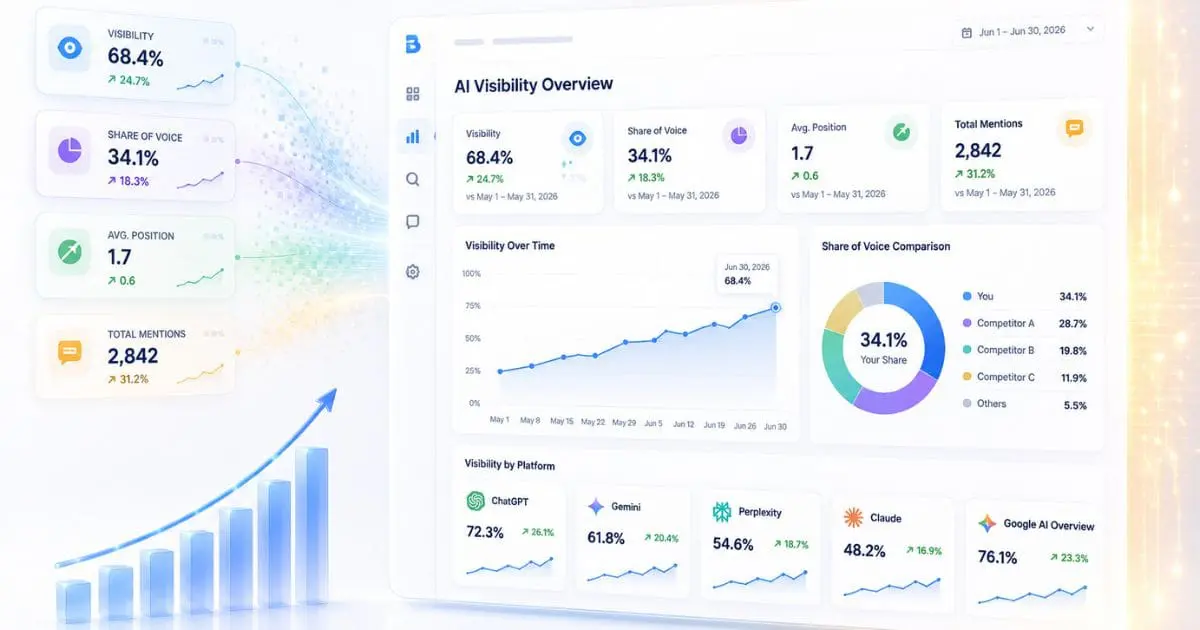
- Visibility & Share of Voice — how often you show up, and what slice of the total conversation is yours versus every competitor tracked. These two numbers often tell different stories, so we track both.
- Average position — when you do get mentioned, are you the first brand named, or an afterthought three sentences in? Being mentioned isn’t the same as being recommended, and position is usually the difference.
- Platform-by-platform comparison — your numbers on ChatGPT, Gemini, Google AI, Claude, Perplexity, and more, side by side with your top competitor. Strong on one platform and invisible on another is common — and worth knowing.
- Topic performance — visibility broken down by the actual topics and questions that matter to your business, so you can see exactly where you’re winning and where you’ve got real gaps, not just an overall average that hides both.
- Citation & source analysis — exactly which websites AI platforms are pulling from when they talk about your category, and whether that’s your own site, a competitor’s, a third-party publisher, or Reddit.
- Engine behaviour patterns — each AI platform has its own habits. Some lean heavily on your own website; others barely touch it and prefer forums or news sites instead. Knowing which is which tells you exactly where to focus.
You’ll always be able to see exactly what’s behind the numbers, not just the score.
The process, start to finish
1. Baseline audit. We run your brand through the prompts your actual customers would ask, not generic industry keywords, and show you exactly where you stand today, across every major AI platform.
2. Topic mapping & prompt generation. We map the topics, products, and services that matter to your business with you. From there, we generate a large, statistically meaningful set of prompts per topic, often hundreds, built to reflect how real customers actually ask questions, not one hand-picked phrase. You vet the topics; we handle the prompt-level detail underneath.
3. Fix what’s broken. Structured data, content clarity, entity signals, technical foundations. The unglamorous work that actually moves the needle on whether AI platforms trust and cite you.
4. Track it properly. Ongoing reporting tied to outcomes you actually care about, not just a score creeping up, but real visibility against real competitors on real questions.
5. Iterate. AI platforms change fast. We adjust the approach as they do, instead of setting and forgetting.
Best alongside SEO, but we can build both together
Straight talk: if your website has serious fundamental problems, AI visibility work alone won’t fix that, and we’ll tell you so upfront.
Already got solid SEO in place? This is the natural next layer. Starting from scratch? That’s fine too, we can scope SEO and AI visibility as one engagement and build both in parallel, rather than making you wait.
FAQ
What’s the difference between SEO and AI visibility (or GEO)?
SEO gets you found on search engines like Google. AI visibility (sometimes called Generative Engine Optimisation, or GEO) gets you cited by AI platforms like ChatGPT and Gemini when they generate an answer. They overlap, good technical SEO helps both, but ranking well on Google doesn’t guarantee an AI assistant will mention you.
Which AI platforms do you actually track?
ChatGPT, Perplexity, Google AI, Gemini, Claude, Grok, and DeepSeek. Not every platform matters equally for every business, we help you prioritise the ones your customers are actually using, rather than tracking all seven by default.
How is this different from me just asking ChatGPT myself?
A question typed into a regular chat app isn’t a reliable measurement as the answer can be shaped by your account history and personalisation, and it only shows you one moment in time. We query these platforms directly, without that personalisation layer, running a large structured set of prompts per topic to get a repeatable, representative picture, not what one chat happened to say to one person on one day.
How do you measure success, if not with a visibility score out of 100?
Visibility, share of voice, and average position against named competitors; broken down by the actual topics that matter to your business, not one blended number. You’ll see exactly which platforms are working for you, which sources AI systems are citing, and where the real gaps are.
How long before we see results?
AI platforms update their sources on different timelines to Google, so it varies, but you’ll see your baseline audit results immediately, and most clients see measurable movement within a similar window to standard SEO work: a few months, not overnight.
Does this replace our existing SEO work?
No, and we’d say so if it did. This runs alongside SEO, using a lot of the same technical foundations, but with its own tracking, its own reporting, and its own set of fixes.
Get your full AI visibility report
See exactly how AI platforms talk about your brand. Where you’re winning, where competitors are winning instead, and what to fix first, backed by real data across every platform that matters to your business.
A focused, fixed-scope engagement, typically 1–3 hours of work depending on how many topics and platforms you want covered. And if you move forward with ongoing work, this report is your baseline, not a sunk cost.