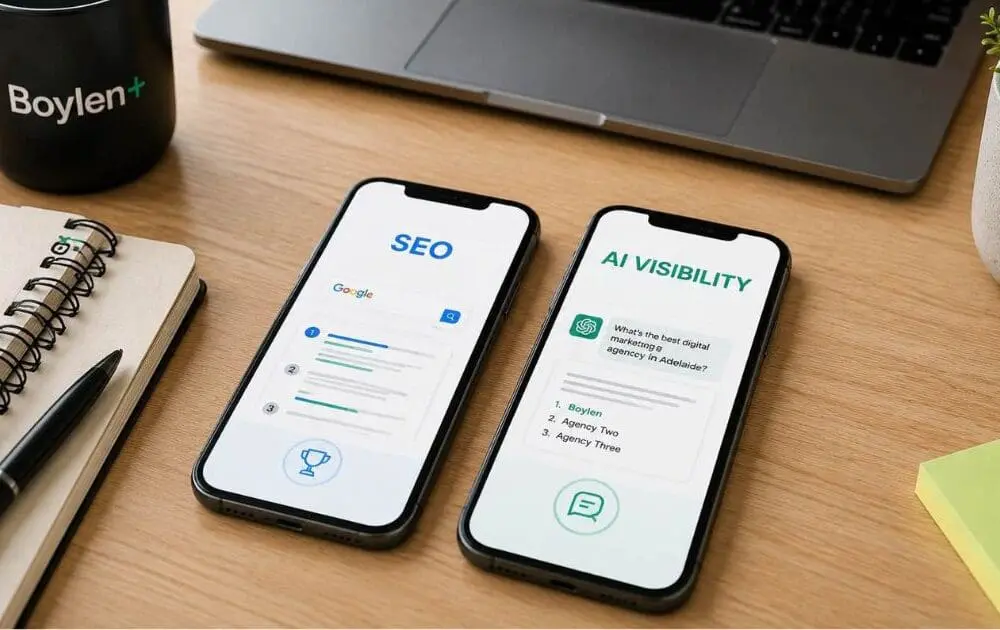
TL:DR
Google’s March and May 2026 core updates knocked plenty of Adelaide businesses down the rankings, including, at one point, us. Here’s what we learned fixing it.
Two major Google core updates landed in 2026: March and May, and both were rough. According to data SE Ranking shared exclusively with Search Engine Land, nearly 80% of top-3 results changed position after the March update, and roughly one in four pages that were sitting in the top 10 dropped out of the top 100 entirely. May was reportedly even heavier.
If your Adelaide business lost ground around then, you’re not imagining it, and you’re not alone. We know, because it happened to us too.
We audited our own SEO page. Here’s what we found.
When our own SEO service page started sliding, we didn’t just blame the algorithm and wait it out. We pulled every old version of the page and worked out what actually went wrong. Two things stood out, and neither of them was really the algorithm’s fault.
We’d stopped saying where we are.
Somewhere between an earlier version of the page and a 2025 rebuild, “Adelaide” and “South Australia” disappeared from our own SEO page entirely, not just from the headline, but from the keyword strategy behind it. For a local business, that’s a real problem. Local search intent is enormous, and a page that reads as generic and placeless doesn’t compete well against one that clearly says who it serves and where.
We planned supporting content and never built it.
The original rebuild plan included eight supporting articles meant to back up the main page with real depth. They never got written. Partly because the SEO landscape was shifting so fast through 2025 and 2026 that it felt sensible to wait and see where things settled before locking in a content plan. Partly because, like most agencies, client work came first, and our own site slipped down the priority list. Both reasons make sense on paper. Neither one changes what actually happened: the page was left making a lot of claims with nothing underneath them, which is precisely the kind of content Google’s 2026 updates were built to catch. Pages that assert expertise without demonstrating it through examples, data, or first-hand experience are exactly what these updates deprioritise.
Put simply: we got hit partly by the algorithm, and partly by our own gaps. Once we saw that clearly, the fix became obvious.
What actually moves the needle after a core update hit
If you’re in the same boat, here’s where we’d point you first, in the order we tackled it ourselves.
1. Check whether your content earns its rankings, or just asks for them
Go through your key pages and ask: does this page prove anything, or does it just claim things? Google’s guidance has been consistent across 2025 and 2026: content that summarises what everyone else says, without real examples, data, or lived experience behind it, is the first to lose ground. Case studies, actual numbers, and named examples aren’t decoration. They’re the difference.
2. Make sure your local relevance is actually on the page, not just implied.
If you’re an Adelaide or South Australian business, say so, clearly, in your headings, not buried in a footer address. This matters even more if you’re trying to recover Google Maps or Local Pack rankings specifically, since local relevance signals feed directly into how Google decides who shows up in local results.
3. Finish what you start.
If you’ve ever planned a content cluster (supporting articles built to back up a main service page) and let it stall, that gap is costing you more than it looks like on the surface. A pillar page with no supporting depth reads as thin no matter how well the page itself is written.
4. Pull your Search Console data and find your actual window.
Don’t assume it was the algorithm. Compare your traffic and rankings in the weeks immediately after any content changes you made, separately from the general 2026 core-update windows. Sometimes what looks like algorithm damage is actually self-inflicted, and that’s good news, because it means the fix is entirely in your hands.
What we’re doing about it
We’ve rebuilt our own SEO page around everything above: Genuine Adelaide and South Australian focus, real case studies with real numbers (not industry averages borrowed from somewhere else), and we’re working through the supporting content cluster we should have built the first time.
If you want the same kind of honest look at your own site, what’s the algorithm, and what’s fixable, that’s exactly the kind of audit we do for clients.